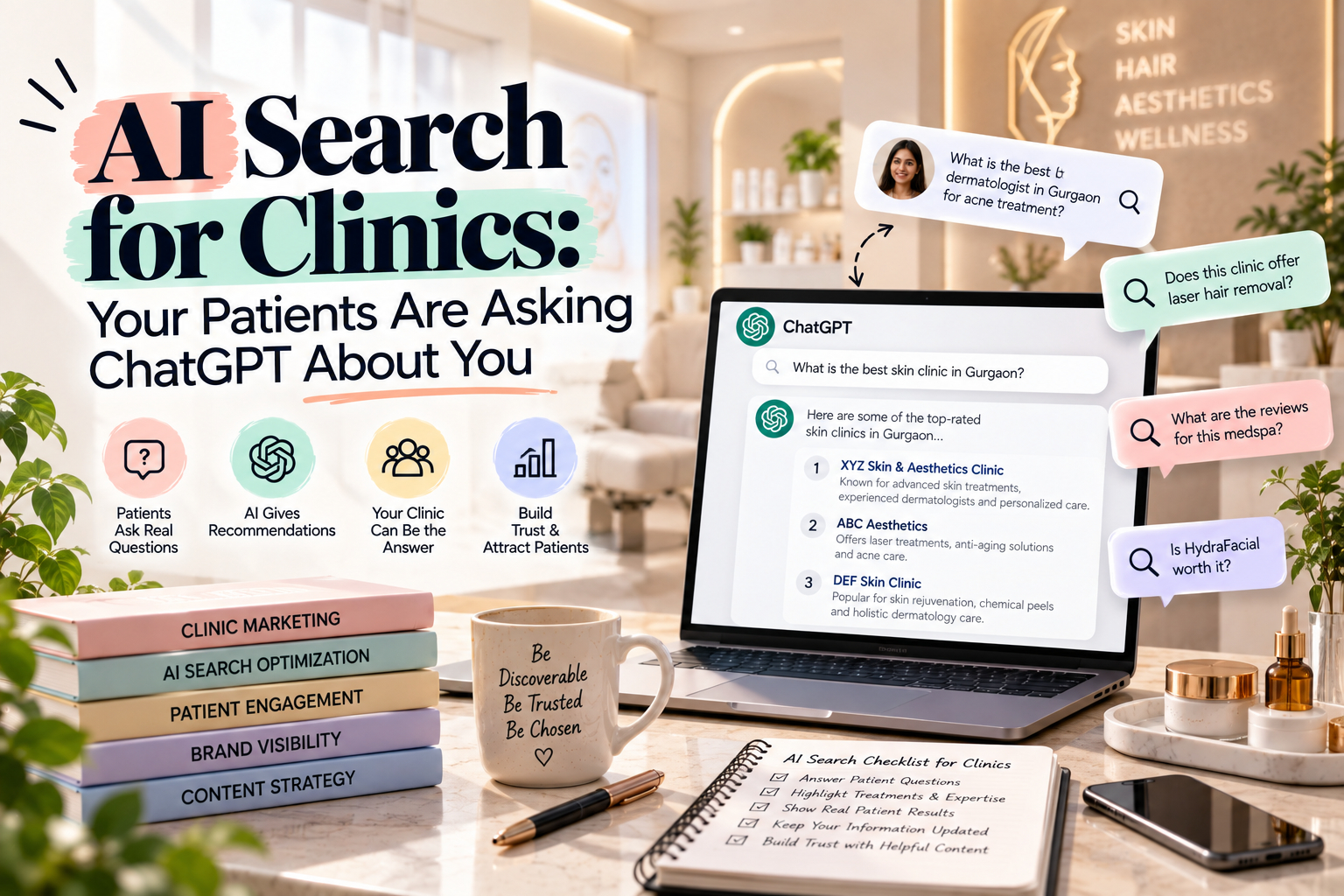
Dear clinic owners, AI search for clinics is no longer a future trend. Patients now ask ChatGPT, Gemini and Google’s AI features which clinic to trust, and the answer names a few practices before anyone opens a website. If your clinic isn’t one of them, you lose the patient before the first call. Picture a patient in Gurugram at 11 pm, looking at acne scars in the mirror. She types into ChatGPT: “Which clinic in Gurugram is good for acne scar treatment, and what does it cost?” In the US, a June 2026 KFF poll found that 29% of adults now use AI tools for health information at least monthly, up from 17% two years earlier. Patients in India are asking the same kinds of questions. Your reputation still matters. What’s changed is where patients check it first. This guide explains how AI tools choose which clinics to mention, five fixes that get clinics named, and a 30-day plan any clinic or MedSpa can follow. Key Takeaways AI search for clinics decides which practices a patient hears about first, often before they visit any website. A June 2026 KFF poll found 29% of US adults use AI tools for health information at least monthly, up from 17% in 2024. AI tools name clinics whose treatment pages, credentials, listings and reviews give clear, consistent and verifiable answers. Five fixes help most: treatment pages that answer, descriptive reviews, up-to-date listings, visible doctor credentials and third-party mentions. Medical content needs extra care: factual statements, doctor review and no promised outcomes. What Happens When a Patient Asks AI for a Clinic? When a patient asks an AI tool for a clinic, the tool searches the web for relevant pages, reads them and writes a short answer that names a few practices. Google’s guidance on AI features and your website confirms that pages must be indexed and eligible to show a snippet to appear as a link in AI Overviews or AI Mode. The tool pulls from several sources at once: Your website – treatment pages, doctor profiles, prices and location details. Listings – Google Business Profile, Practo, Justdial and similar directories. Reviews – what patients say about specific treatments and doctors. Third-party mentions – local news, health features and forum answers that mention your clinic. That makes healthcare AI search different from classic clinic SEO. Ranking your homepage isn’t enough. The tool needs clear facts it can repeat with confidence, and it checks them against what other sources say. Where Clinics Lose Patients Before the First Call Most clinics that never appear in AI answers share one of three gaps: Vague treatment pages – a single “Skin Treatments” page listing 20 services gives an AI tool nothing specific to quote about acne scars, pigmentation or hair loss. Hidden credentials – doctor qualifications live only in a photo of a certificate, or not on the site at all. Mismatched details – the clinic’s timings, address or doctor list differ between the website, Google Business Profile and Practo, so the tool can’t tell which is right. Each gap is fixable in a few weeks, and fixing them helps both regular clinic SEO and AI answers. Five Fixes That Help AI Search for Clinics These five fixes cover what AI search for clinics looks for, and each one also strengthens regular clinic SEO. 1. Write treatment pages that answer patient questions Create one page per treatment. Open with a 40 to 60 word answer covering what the treatment is, who it suits, how many sessions it usually takes and the price range. Then cover downtime, aftercare and who performs it. Use question headings patients actually type, such as “How many sessions does laser hair removal need?” This answer-first layout is the heart of answer engine optimization, and it gives AI tools a clean block to quote. 2. Collect reviews that describe the treatment Ask happy patients to mention the treatment and the location in their reviews, such as “PRP for hair fall at the Sector 56 clinic.” Descriptive reviews tell AI tools what your clinic is known for. Reply to every review, including critical ones, calmly and without sharing patient details. A steady flow of genuine reviews matters more than a sudden spike. 3. Keep every listing up to date Keep your name, address, phone, timings, doctors and services identical across your website, Google Business Profile, Practo and other directories. Add treatment categories and photos, and post updates regularly. When details match everywhere, AI tools can describe your clinic with confidence. When they don’t, the tool may skip you or give patients the wrong timings. 4. Show your doctors’ credentials Give every doctor a profile page with qualifications, registration details, years of practice and the treatments they perform. Write it in plain text, not inside an image. Add structured data from schema.org, such as MedicalClinic and Physician, so machines can read who works at your clinic and what they do. This is also where “ChatGPT for doctors” questions get answered: patients often ask about a specific doctor by name. 5. Earn mentions on other trusted sites AI tools trust what others say about you. Offer your doctors as expert sources for local health features, answer patient questions on Quora with care, and join health awareness events that get covered online. This is the generative engine optimization side of AI search for clinics: the more credible sources connect your clinic with a treatment, the more likely AI tools are to name you. Guardrails for Medical Content in AI Search Health content affects people’s wellbeing, so both Google and AI tools hold it to a higher standard. Follow these guardrails on every page: State facts, not promises – say what a treatment involves and who it suits, never “guaranteed results.” Get doctor review – have a qualified doctor check every treatment page and add a “medically reviewed by” line. Show ranges, not fixed prices – price ranges with the factors that change them are more honest and more
How Much Does SEO Cost in India? What You Should Expect to Pay
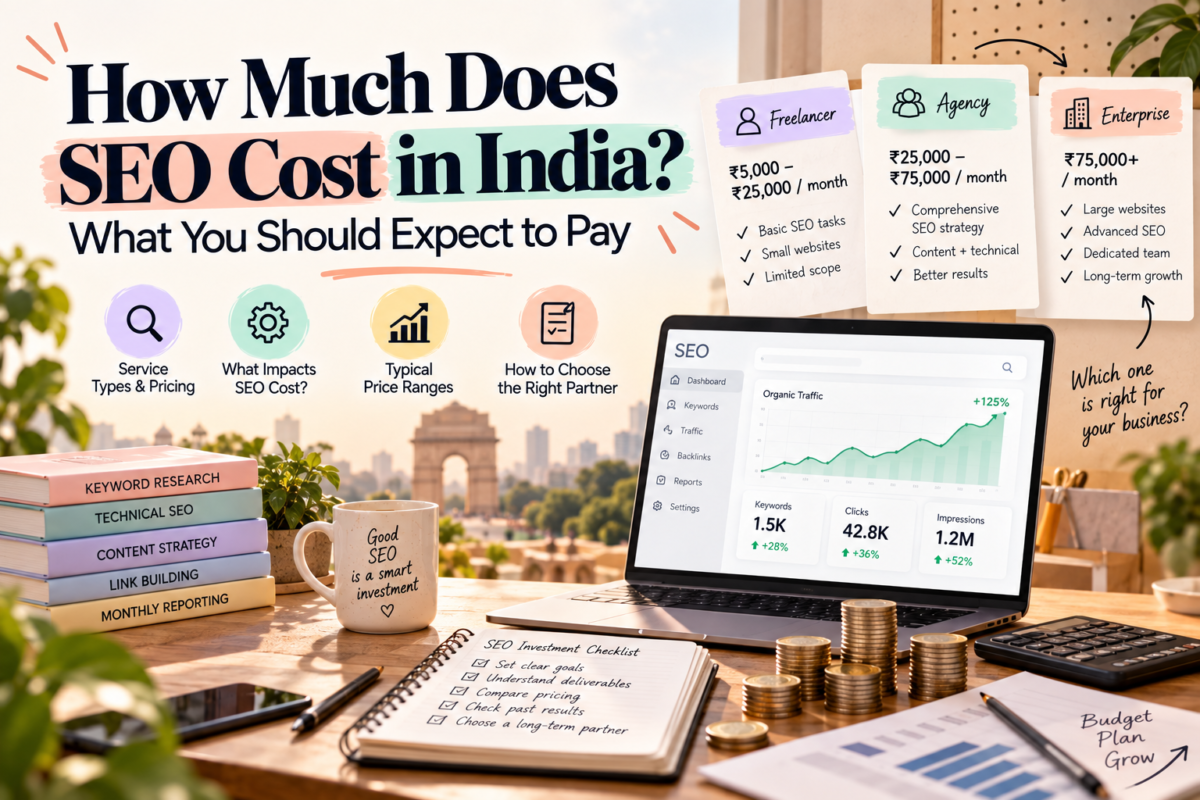
SEO cost in India in 2026 usually ranges from about ₹10,000 to ₹30,000 a month for local businesses, ₹30,000 to ₹75,000 for growing brands, and ₹75,000 to ₹2 lakh or more for competitive, national or ecommerce work. Freelancers often charge ₹5,000 to ₹15,000 a month. If you’ve collected a few quotes, you’ve probably seen numbers ten times apart for what sounds like the same service. SEO cost in India also comes with a time commitment. Google’s own guide, Do you need an SEO?, notes that in most cases an SEO needs four months to a year to implement improvements and then see potential benefit. The real question isn’t what SEO costs. It’s what the quote includes. This guide to SEO cost in India covers typical pricing, the factors behind it, what each budget buys, the SCOPE Check for comparing quotes, and a 60-day plan for choosing and onboarding a provider. Key Takeaways What Does SEO Pricing Look Like in India in 2026? Most SEO packages in India fall into five bands. These ranges reflect 2026 price lists published by Indian SEO agencies, such as those from Noir & Blanco and The Digital Socialite: Business type Typical monthly cost (2026) What’s usually included Freelancer support ₹5,000–₹15,000 On-page fixes, basic keyword tracking, limited content Local business (single clinic, store or broker) ₹10,000–₹30,000 Google Business Profile, local keywords, on-page SEO, 1 or 2 content pieces, monthly report Growing brand (multi-location, B2B, mid-size) ₹30,000–₹75,000 Technical SEO, 4 to 8 content pieces a month, link building, answer-first formatting Competitive, national or ecommerce ₹75,000–₹2,00,000+ Senior strategist, larger content and PR programs, technical SEO at scale, AI visibility tracking One-time SEO audit ₹10,000–₹50,000 (one-time) Technical, on-page and content review with a prioritized fix list Treat these bands as a starting point for judging SEO cost in India. The scope behind a number matters more than the number itself. Seven Factors That Push Your Monthly SEO Cost Up or Down SEO cost in India changes with seven factors, and two quotes can differ widely because they cover different combinations of them: What Does Each SEO Budget Actually Buy? Each band of SEO cost in India buys a different depth of work: The SCOPE Check for Comparing SEO Quotes The SCOPE Check is a five-point test for judging SEO cost in India on value, whatever the price: Scope in writing, Competition fit, Outcomes reported, Proof of method and Exit terms. S: Scope in writing Ask for a written list of monthly deliverables: how many pages optimized, how many content pieces, which technical fixes and how much outreach. A quote that only says “SEO activities” can’t be compared with anything. C: Competition fit Check that the budget matches your market. A local clinic doesn’t need an enterprise retainer, and a national ecommerce brand won’t move on a local package. Ask the provider which competitors they’d benchmark you against and why. O: Outcomes reported Good reports connect work to business results: rankings, organic traffic, inquiries and leads, and now mentions in AI answers. Screenshots of keyword positions alone don’t tell you whether your monthly SEO cost is paying off. P: Proof of method Ask how they build links and create content, and request examples. Google’s spam policies treat link schemes and scaled, low-value content as violations, so “500 backlinks” for a low fee is a warning sign, not a bargain. E: Exit terms Confirm who owns the content, website changes and your Search Console and Analytics accounts, what the notice period is, and what happens to the work if you stop. You should keep everything you paid for. What to check Green flag Red flag Timeline Explains that results usually take several months Guarantees page-one or “No. 1” rankings within weeks Scope Written list of monthly deliverables Vague “SEO activities” Links Outreach to relevant sites and genuine PR Bulk backlinks or directory submissions for a low fee Reporting Rankings, traffic, leads and AI mentions Keyword position screenshots only Ownership You own content and Google accounts Agency controls your accounts Eight Questions to Ask Before You Sign an SEO Contract Before you compare SEO pricing across providers, get written answers to these eight questions. The answers make the SCOPE Check quick and show you how each provider really works: If a provider can’t answer these clearly and in writing, its monthly SEO cost is hard to judge, however attractive the number looks. A good partner will welcome the questions, because clear answers protect both sides. A 60-Day Plan to Choose and Onboard an SEO Partner Once you understand SEO cost in India, use this plan to go from a pile of quotes to a working SEO engagement: Phase What to do Days 1 to 10 Define one goal (such as more consultation bookings or site visit requests), list your 10 to 15 priority services or locations, and set a budget band Days 11 to 25 Shortlist three providers, send each the same brief, and run every quote through the SCOPE Check Days 26 to 40 Sign with written deliverables, give access to Search Console and GA4 while keeping ownership, and agree on a baseline report Days 41 to 60 Review the first audit and 90-day roadmap, confirm the first technical and content fixes are live, and fix the monthly report format For the on-page basics any good provider should cover in the first months, see our content optimization checklist. How idatecontent Scopes SEO Work At idatecontent, we start with your business goal and your competition, then scope the content, technical and AI search work needed to reach it. Every monthly deliverable goes in writing, and reports track rankings, traffic and inquiries together, so you can see what your SEO cost in India is buying. Pay for Scope, Not Just a Price SEO cost in India depends less on the price tag and more on the work behind it. Match your budget to your competition and goals, insist on a written scope, and judge progress by leads as well as rankings. This
AI Search Optimization for Indian Businesses: The 2026 Guide
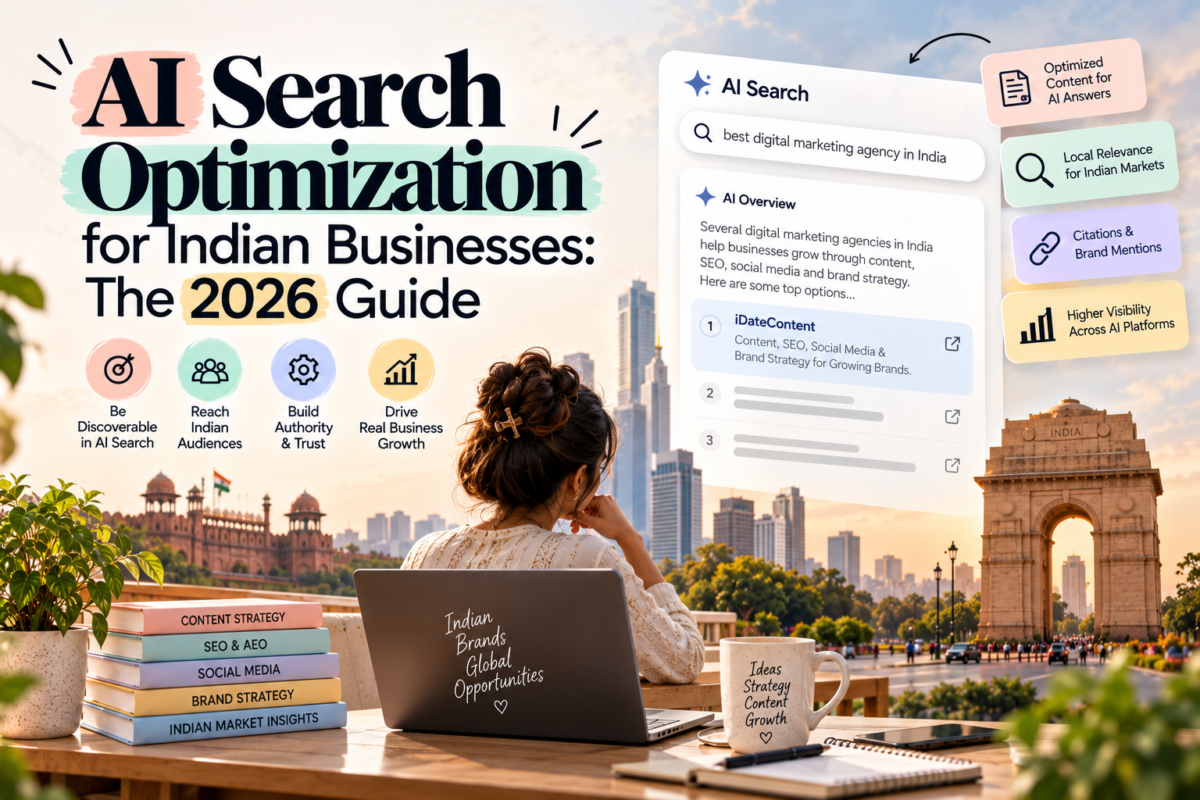
AI search optimization is the practice of shaping your website and online presence so AI-powered search tools can understand your brand, trust it and cite it in their answers. It builds on SEO and adds two layers: answer engine optimization and generative engine optimization. The audience for AI search optimization is already there. Google said in July 2025 that AI Overviews had reached 2 billion monthly users across more than 200 countries and territories, and that AI Mode had passed 100 million monthly active users in the US and India. A patient in Gurugram can now ask Gemini for a dermatologist, and a founder can ask ChatGPT which CRM suits a 20-person team. The brands named in those answers get the inquiry first. Ranking still matters, but it’s no longer the finish line. The new question is whether AI tools name you when your customers ask. This AI search optimization guide covers how AI search picks its sources, the CITED Framework, examples for clinics, real estate and B2B brands, and a 90-day plan. Key Takeaways How Do AI Search Tools Pick the Brands They Mention? AI search tools usually work in two stages. First, they retrieve pages that seem relevant to the question from a search index or web crawl. Then a language model reads those pages and writes a summary, often linking the sources it used. Google’s guidance on AI features and your website says there are no special requirements beyond SEO best practices: a page must be indexed and eligible to show a snippet in Search to appear as a link in AI Overviews or AI Mode. In practice, three things decide whether your brand shows up: A Noida developer whose project page lists the RERA number, possession timeline, unit sizes and distance to the metro in plain sentences is far easier to quote than a page of brochure images with the details locked in a PDF. What Does AI Search Optimization Cover? AI search optimization, often called AI SEO, works on three layers, and each one depends on the layer below it: We’ve covered the last two layers in our guides to answer engine optimization and generative engine optimization, and compared all three in AEO vs GEO vs SEO. Five Gaps That Keep Indian Brands Out of AI Answers Most brands that skip AI search optimization share one or more of these gaps: The CITED Framework for AI Search Optimization The CITED Framework turns AI search optimization into five working steps: Crawlable foundations, Intent-led questions, Tight answer-first pages, Evidence AI can cite and a Distributed, consistent brand presence. C: Crawlable foundations AI search optimization starts with crawlability: if Google can’t crawl and index a page, its AI features can’t use it. Verify your site in Google Search Console, submit a sitemap, fix pages marked “not indexed” and keep key facts in plain text, not behind scripts or logins. Add structured data using schema.org types that fit your pages, such as Organization, LocalBusiness or MedicalClinic, Article and Product, and test each template with Google’s Rich Results Test. I: Intent-led questions List the questions buyers ask at each stage, in their own words. Questions typed into AI tools tend to be longer and more conversational, such as “which dermatologist in Gurugram is best for acne scars and what does treatment cost?” Ask yourself what customers ask on the first call, which options they compare you with, and what worries them before they pay. Then add questions from “People also ask” and Search Console. Our guide on how to find content ideas covers more sources. T: Tight, answer-first pages Put a 40 to 60 word answer to the page’s main question at the top, and open every section with a sentence that answers its heading. This is the core of answer engine optimization, and it gives AI tools a clean block to quote. On a real estate page, “When is possession for Tower B?” followed by “Possession for Tower B is scheduled for [month and year], as per the project’s RERA registration” beats a paragraph about lifestyle. Our content optimization checklist covers the other on-page checks. E: Evidence AI can cite The research paper that introduced generative engine optimization found that adding statistics, quotations and cited sources made content more visible in AI-generated answers. Every key page needs real numbers, named sources and first-hand detail. A clinic can list each doctor’s qualifications and years of practice. A developer can publish dated construction updates. A B2B brand can share a small benchmark from its own customers. D: Distributed, consistent brand presence AI tools build their picture of a business from many sources: your website, Google Business Profile, directories, reviews, LinkedIn and news mentions. Keep your name, services, location and positioning identical everywhere. Then earn mentions beyond your site: expert quotes in industry publications, helpful answers on Quora or Reddit where your buyers ask questions, and original data others will reference. AI Search Optimization for Clinics, Real Estate and B2B Brands The CITED steps apply everywhere, but AI search optimization looks different in each industry: A 90-Day AI Search Optimization Plan This AI search optimization plan suits a small team working alongside regular SEO: Phase Focus Tasks Days 1 to 30 Foundations and questions Fix indexing issues, add Organization and LocalBusiness schema, list 30 buyer questions, and record a baseline by asking 10 of them in ChatGPT, Gemini, Perplexity and Google AI Mode Days 31 to 60 Answer-first pages and evidence Rewrite your top 10 pages answer-first, add credentials, dates and sourced numbers, and publish 4 to 6 pages that answer the top buyer questions Days 61 to 90 Brand presence and review Align Google Business Profile and listings, earn 2 or 3 third-party mentions, then repeat the 10-question check and compare it with your baseline How Do You Track Visibility in AI Overviews and AI Chats? Measure AI search optimization with a mix of mention tracking, traffic and lead data: Metric Where to find it What it tells you Brand
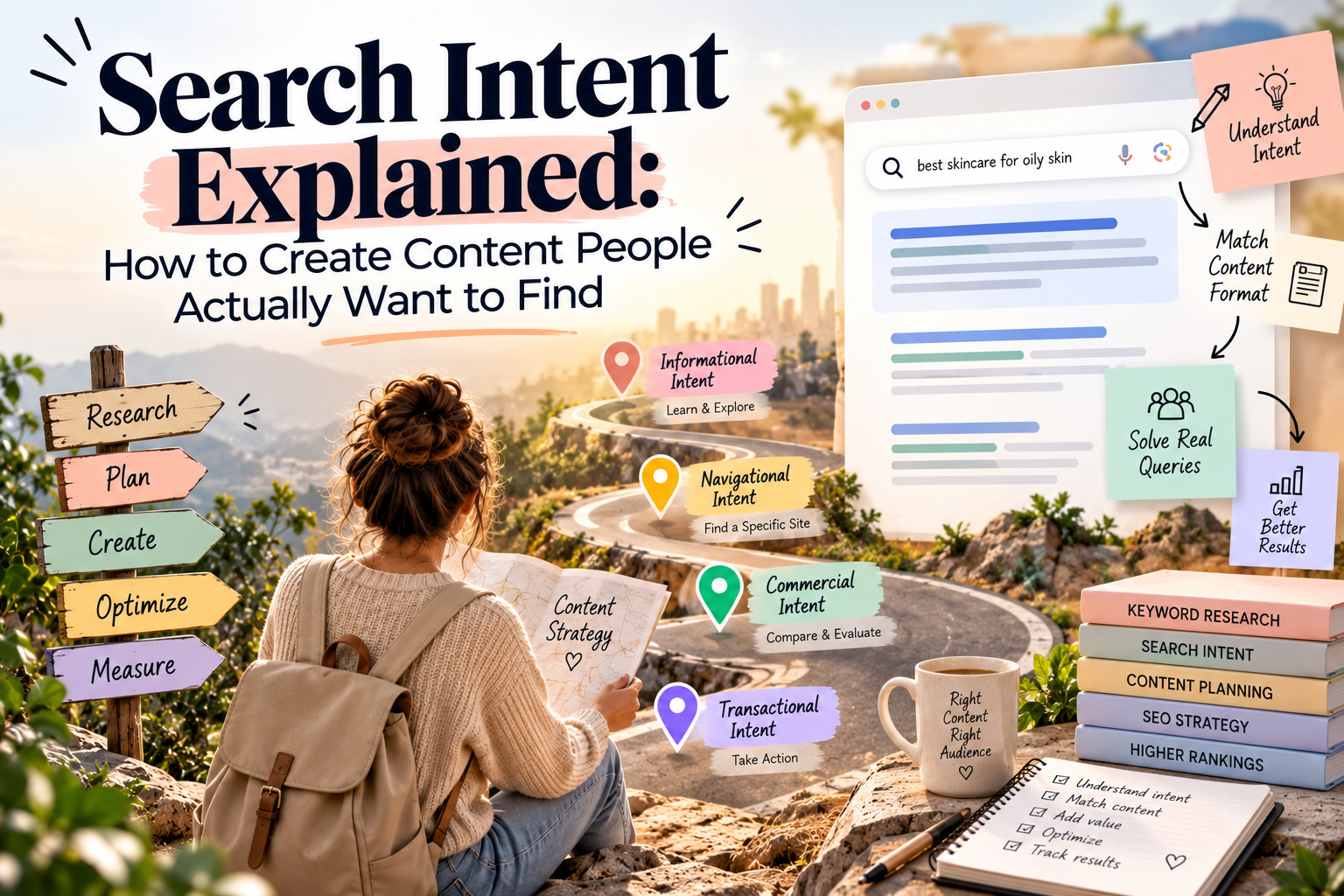
Search Intent Explained: How to Create Content People Actually Want to Find
Search intent is the goal behind a search: what the person typing a query actually wants to learn, find, compare or do. Google ranks the pages that match that goal best, which is why a detailed article can lose to a simple price list. Matching search intent is the first job of every page you publish. You may have seen this on your own site. A clinic spends a week on a thorough guide to laser hair removal, and it sits on page two while a short price page from across town ranks first. Google’s Search Quality Rater Guidelines ask raters to judge how well a page meets the needs behind a query, not how much it says. Most pages that don’t rank don’t have a writing problem. They have an intent problem. This guide covers the four types of search intent, the READ Framework for matching them, and a 30-day plan to fix the pages you already have. Key Takeaways How Does Google Read the Intent Behind a Query? Google works out what a searcher means before it picks results. Its How Search Works pages explain that it analyzes the meaning of a query and looks for content that fits it. Its rater guidelines go further and sort queries by what the user wants to accomplish: SEO tools use slightly different labels, but the idea is the same. User intent decides the format Google wants to show as much as the topic does. What Are the Four Types of Search Intent? Most SEO tools group search intent into four types. A search can mix two, but one usually leads, and that’s the one your page should serve. Informational intent Informational intent covers questions like “what is a chemical peel” or “how does a home loan work.” The searcher isn’t ready to buy yet. They want a clear explanation, ideally with a quick answer at the top. Guides, how-to posts and explainers rank well here. These pages build trust early, so each one should link to a logical next step, like a comparison or a service page. Navigational intent Navigational searches include a brand or site name, such as “HubSpot login.” The person knows where they want to go and uses Google as a shortcut. You can’t win navigational search intent for another brand’s name. Make sure searches for your own brand lead to a clean homepage, an up-to-date Google Business Profile and clear service pages. Commercial intent Commercial intent shows up in searches like “best CRM for small business” or “HydraFacial vs chemical peel.” The person plans to buy soon but is still weighing options. Comparisons, reviews and case studies work well for commercial intent. A B2B software brand that compares itself honestly against two alternatives, drawbacks included, earns more trust than a page that only praises its own features. Transactional intent Transactional searches include “book laser hair removal Gurgaon” or “2BHK flats for sale in Noida Extension.” The person wants to act now. Service, pricing and booking pages rank for these searches, while long blog posts rarely do. Meet this search intent with a clear offer, a price range, proof and one obvious next step. Intent type What the searcher wants Example search Content that ranks Informational To learn or understand how does a home loan work Guides, explainers, how-to posts Navigational To reach a specific site HubSpot login Homepage, brand and login pages Commercial To compare before buying best CRM for small business Comparisons, reviews, case studies Transactional To buy, book or inquire book HydraFacial in Gurgaon Service, pricing and booking pages Three Mismatches That Keep Good Pages Off Page One When a well-written page won’t rank, one of three search intent mismatches is usually the cause: Fixing the mismatch often does more than adding words. Once intent is right, our content optimization checklist covers the remaining on-page checks. The READ Framework for Matching Search Intent The READ Framework is a four-step way to match any page to its search intent before you write or rewrite it: Read the results, Establish the intent, Align the format and Deliver the answer early. R: Read the results page Search your keyword in a private browser window and study the first page. Note the content types that rank, the angle (beginner, cost, comparison) and features like maps, videos or a “People also ask” box. Google has already tested what satisfies this search. Before moving on, ask yourself three things. What type of page holds the top three spots? Is the searcher trying to learn, compare or act? What would they need to see in the first five seconds? Check results from the city you’re targeting, since local searches change by location. E: Establish the intent type Add an intent column to your keyword sheet and tag every term as informational, navigational, commercial or transactional. This search intent SEO habit takes minutes and stops you from writing a blog post for a keyword that needs a service page. Trigger words help. “What,” “how” and “guide” usually signal informational intent. “Best,” “vs” and “review” signal commercial intent. “Price,” “book,” “buy” and a location usually mean the searcher is ready to act. A: Align the format Pick the format the results reward before you write a word. Informational keywords need guides or checklists, commercial keywords need comparisons with honest pros and cons, and transactional keywords need service or product pages with pricing and a clear call to action. A real estate advisor targeting “ready to move vs under construction flats” should write a comparison. The same advisor targeting “ready to move flats in Gurgaon” needs a listings page. When results mix guides and service pages, build the type you can make best and link it to the other. D: Deliver the answer early Put the main answer, price range or offer in the first 40 to 60 words, then add detail. Short, direct answers are also what featured snippets and AI Overviews pull, which is where search intent meets answer engine optimization
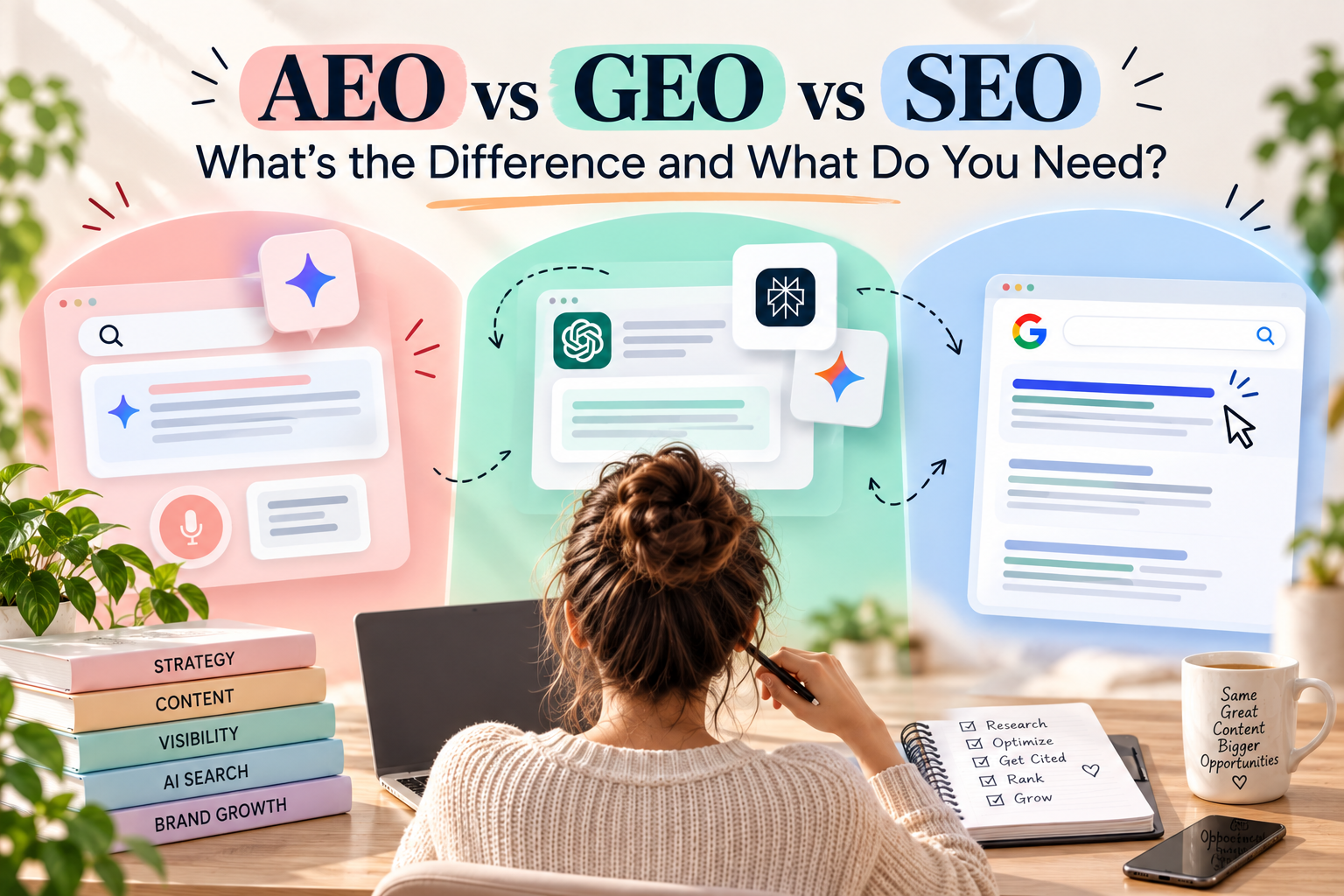
AEO vs GEO vs SEO: What’s the Difference and What Do You Need?
Your monthly SEO report says rankings are up. Then a client mentions she found your competitor through ChatGPT, and a prospect tells you Google’s AI summary answered her question before she reached your site. Now three acronyms keep landing in your inbox, and every agency pitch promises all of them. Here’s the short version. SEO gets your pages ranked in search results. Answer engine optimization (AEO) gets your content picked as the direct answer in featured snippets, voice search and AI Overviews. Generative engine optimization (GEO) gets your brand mentioned and cited inside AI chat answers. This guide explains each one with examples for clinics, real estate firms and B2B brands, and shows you which to work on first. Key Takeaways What Changed in Search Over the Last Two Years Search used to end with ten blue links. Now many searches end on the results page itself. Google shows AI features like AI Overviews above the links, and people ask ChatGPT, Perplexity and Gemini questions they once typed into Google. You can rank well and still get fewer visits if your content isn’t part of those answers. That’s why answer engine optimization and GEO became agency buzzwords in 2025 and 2026. Both describe ways to show up in answers as well as in rankings. The confusion comes from the overlap, because the same well-written page often helps with all three. SEO, AEO and GEO Explained in Plain Words 1. SEO: getting your pages ranked Search engine optimization helps your pages rank in Google’s regular results. It covers keyword research, SEO writing, internal links, page speed and backlinks. Google’s own SEO Starter Guide is still the best free overview of the basics. Success looks like a real estate firm ranking on page one for “2BHK flats in Noida Extension” and getting enquiries from that traffic. You measure it with rankings, clicks and leads in Google Search Console. 2. Answer engine optimization: becoming the direct answer Answer engine optimization shapes your content so search engines and voice assistants can lift one clear answer from it. The targets are featured snippets, the “People also ask” box, Google’s AI Overviews and spoken answers from Siri or Alexa. A clinic that answers “how long does Botox take to work” in the first two lines of a post, under a heading that repeats the question, is doing answer engine optimization. The reader may get the answer without clicking, but your brand is the one giving it. 3. GEO: getting cited by AI chat tools Generative engine optimization aims to get your brand mentioned or cited when tools like ChatGPT, Perplexity or Google’s AI Mode write an answer. The term comes from a 2023 research paper by researchers at Princeton, IIT Delhi and other institutions, which found that adding statistics, quotations and cited sources made content more likely to appear in AI-generated answers. For a B2B SaaS brand, GEO success looks like ChatGPT naming you when someone asks for the best payroll software for Indian startups. That depends on your own pages and on what reviews, directories and articles across the web say about you. GEO also builds on answer engine optimization, since a page that already gives a clean answer is easier for AI tools to cite. Answer Engine Optimization, GEO and SEO Side by Side Here’s how the three compare side by side: Comparison Point SEO Answer Engine Optimization (AEO) Generative Engine Optimization (GEO) Goal Rank pages in search results Be the direct answer Be cited or mentioned in AI answers Where you show up Google and Bing results Featured snippets, People also ask, AI Overviews, voice search ChatGPT, Perplexity, Gemini, Google AI Mode What it rewards Relevance, links, technical health Clear question-and-answer structure, schema Proof, statistics, brand mentions across the web How you measure it Rankings, clicks, leads Snippet wins, AI Overview appearances Mentions in AI answers, referral traffic from AI tools The overlap is bigger than the differences. All three reward content that answers a real question clearly, comes from a credible source and stays up to date. Where Should Your Brand Start? Most businesses need all three eventually, but the order matters. Start with what brings enquiries now and build from there: A Gurugram clinic with a two-year-old site that ranks for a few treatment pages sits in the middle group. For that clinic, answer engine optimization on its ten best-performing pages is likely to bring results sooner than chasing mentions in ChatGPT. Writing One Page That Works for Search, Snippets and AI Chats You don’t need three strategies or three agencies. You need SEO content written so each page works for rankings, direct answers and AI citations at once. Answer first on every page – Put a 40 to 60 word answer to the main question at the top, then add detail. This one habit covers most of answer engine optimization and helps AI tools quote you accurately. Add proof AI tools can cite – Include your own numbers, client examples, expert quotes and links to credible sources. Pages with specifics are easier to trust and easier to cite. Earn mentions beyond your site – Keep your Google Business Profile updated, collect reviews, and get featured in industry roundups and local directories. AI tools pull from these sources when they describe a brand. Your social content can use the same questions. An answer that works in a blog post also works as a Reel or carousel, and our guide on how to find content ideas shows where to find the questions your audience is asking. Start With the Question Your Customer Is Asking SEO, answer engine optimization and GEO describe where your content shows up: in rankings, in direct answers or inside AI chats. The work behind them overlaps heavily. Write clear, helpful SEO content, answer questions early, and give search engines and AI tools proof worth citing. This week, pick your five most visited pages and check whether each one answers its main question in the first two lines.
What Is Generative Engine Optimization? A Clear Guide for Brands in 2026
Your customers still search. They just don’t always search on Google anymore. More and more of them type a full question into ChatGPT, Gemini or Perplexity and trust whatever comes back. If your brand isn’t part of that answer, you’re invisible at the exact moment someone is ready to decide. Generative engine optimization is how you fix that. This guide covers what GEO is, why it matters now, how it compares with SEO and answer engine optimization, and the practical content optimization steps that help AI tools recommend you. Key Takeaways Generative engine optimization (GEO) means shaping your content so AI platforms cite, quote or recommend your brand in their responses. GEO works alongside SEO. Rankings still help, but AI tools also reward clarity, evidence and what others say about you. Research from Princeton, Georgia Tech and IIT Delhi found GEO tactics can lift AI visibility by up to 40%. The new success metric is how often you appear inside AI answers, not just how many clicks you earn. What Is Generative Engine Optimization? Generative engine optimization is the practice of making your content easy for AI systems to understand, trust and quote. Where SEO earns you a spot on a results page, GEO earns you a mention inside the answer itself. The idea has academic roots. A research team from Princeton, Georgia Tech, the Allen Institute for AI and IIT Delhi formalized the term in a 2024 paper presented at KDD, a leading data science conference. Their tests showed that the right content changes could raise a source’s visibility in AI answers by as much as 40%. Put simply, GEO asks one question of every page you publish. If an AI pulled a single paragraph from it, would that paragraph be clear, credible and worth repeating? Generative engine optimization in brief: Generative engine optimization (GEO) is the practice of structuring and writing content so AI tools such as ChatGPT, Gemini, Perplexity and Google AI Overviews cite it in their answers. Researchers from Princeton, Georgia Tech and IIT Delhi formalized GEO in 2024 and found it can raise AI visibility by up to 40%. Why Does Generative Engine Optimization Matter Right Now? GEO matters because people increasingly get their answers without clicking through to a website. OpenAI reported 900 million weekly ChatGPT users in February 2026, more than double the figure from a year earlier. On Google’s side, BrightEdge data shows AI Overviews now appear on nearly half of all tracked searches. That shift changes where attention goes. Pew Research Center found that when an AI summary appeared on Google, users clicked a regular search result in just 8% of visits. Without the summary, that number nearly doubled to 15%. Links inside the AI summary itself were clicked in only 1% of visits. Does that mean search traffic no longer matters? Not quite. The visitors who do arrive from AI platforms often arrive ready to act. Adobe Analytics found AI-referred shoppers on US retail sites converted 42% better than other traffic in March 2026. Fewer visitors, but warmer ones, and the brands named in the answer get them. Why GEO matters in brief: AI-generated summaries are reducing clicks to websites. Pew Research Center (2025) found Google users clicked a standard search result in 8% of visits when an AI summary was present, compared with 15% without one. For brands, being named inside AI answers is becoming a primary route to visibility. GEO vs. SEO vs. AEO: What’s the Difference? SEO, answer engine optimization and generative engine optimization build on each other, but each targets a different result. You need all three working together. Tips SEO Answer Engine Optimization Generative Engine Optimization What it aims for High rankings in search results Direct answers and featured snippets Mentions and citations in AI responses Where it shows up Google, Bing Snippets, voice search, AI Overviews ChatGPT, Gemini, Perplexity, Claude, AI Mode How you measure it Rankings and clicks Snippet wins Brand mentions and share of AI answers Answer engine optimization works best for single, well-defined questions. You write the cleanest answer and aim to own that spot. GEO takes a broader view. AI tools stitch together information from several sources, so GEO focuses on becoming one of the sources they trust enough to include. The two don’t always line up with Google rankings. A 2026 benchmark by ConvertMate found only 6.82% of ChatGPT results also appear in Google’s top 10, and 83% of AI Overview citations come from pages outside the organic top 10. Strong SEO keeps you in the game. GEO decides whether AI tools actually pick you. How Do AI Engines Decide Which Brands to Mention? AI engines lean toward sources that are specific, well-supported, easy to extract and referenced by others. Vague, generic content rarely makes the cut. The Princeton-led study measured this directly. Adding relevant quotations improved visibility by up to 41%, adding statistics by 30 to 40%, and citing credible sources by around 30%. Keyword stuffing, on the other hand, performed worse than making no changes at all. The tactics that once gamed search engines now work against you. There’s an encouraging detail for growing brands. Lower-ranked sites in the study saw the biggest gains. Pages ranked fifth improved their AI visibility by 115% after adding source citations, while top-ranked pages saw no such lift. Quality and clarity can outweigh size. Your reputation off-site plays a big part too. Research from Muck Rack found 82% of AI citations come from earned media, such as news coverage and third-party articles, rather than brand-owned pages or paid placements. How AI picks sources in brief: AI engines favor content that is specific, evidence-backed and mentioned by third parties. The 2024 Princeton-led GEO study found quotations, statistics and cited sources raised AI visibility by 30 to 41%, while keyword stuffing lowered it. Muck Rack research found 82% of AI citations come from earned media. Generative Engine Optimization Tactics You Can Use Today The most effective GEO approach is to create content
Answer Engine Optimization: A Simple Guide That Works
Search results don’t look the way they did two years ago. Ask Google a question today and you often get a written answer at the top, with three or four small source links beside it. Your customer reads the answer, gets what they needed, and never scrolls. Answer engine optimization is how you get your brand into that answer. It’s the practice of writing and structuring content so AI-powered tools, including Google AI Overviews, ChatGPT, Perplexity and voice assistants, can pull a clear answer from your page and credit you as the source. It doesn’t replace your SEO work. It changes what you do with the content you already have, so machines can find a specific answer on your page and lift it cleanly. This guide covers what AEO is, how it differs from SEO and GEO, and seven steps you can apply to your own pages this week. Key Takeaways AEO makes your content easy for AI tools to extract, understand and cite. The core format is a question as the heading with a 40 to 60 word answer directly below it. AI systems favour content with specific numbers, named sources, clear structure and consistent brand information across the web. You can measure AEO by testing a fixed list of buyer questions each month and tracking AI referral traffic in GA4. Why Answer Engine Optimization Matters Now AI answers are no longer a side feature. Google announced at I/O 2026 that AI Mode crossed 1 billion monthly users within twelve months of launch, while AI Overviews reach 2.5 billion monthly users. BrightEdge data from February 2026 put AI Overviews on roughly 48 to 50% of US Google searches, up from about 6.5% in January 2025. The click behaviour is the part that should get your attention. A Pew Research Center study of 68,879 searches found that users clicked a traditional result in 8% of visits when an AI summary appeared, compared with 15% when it didn’t. They clicked a link inside the summary itself in only 1% of visits. Read those together and the shift is clear. Ranking still matters, because AI tools draw from pages that already rank. But ranking alone no longer guarantees a visit. Being named in the answer is now part of the job. AEO vs SEO vs GEO: What’s the Difference? These three overlap heavily, which is why most articles blur them. Here’s the practical split: Category What it targets What success looks like Main lever SEO Position in the list of blue links Higher rankings and clicks Relevance, authority, technical health AEO The direct answer slot in AI Overviews, featured snippets and voice Your page is the quoted answer Clear, extractable answers to specific questions GEO Mentions inside longer AI responses in ChatGPT, Perplexity and Gemini Your brand is named and linked Entity consistency and off-site presence You don’t choose one. SEO gets your page indexed and ranked, AEO makes a passage on it quotable, and GEO builds the reputation signals that make AI tools comfortable naming you. Treat AEO as a layer of content optimization on top of the SEO content you already publish. How to Do Answer Engine Optimization: 7 Steps Step 1: Find out where you stand today Before changing anything, check what AI tools currently say about your category. Write down 20 to 30 questions a buyer would ask before purchasing from you. Run each one in Google, ChatGPT, Perplexity and Gemini, and record three things: whether your brand appears, which sites get cited, and what the answer gets wrong. This takes about an hour and gives you a baseline. It usually also shows that the sites being cited aren’t the ones ranking first. That gap is your opening. Step 2: Build your question list from real language Your next posts should answer questions people actually type, in their words. Pull from four sources: Google’s “People also ask” box for your main topics Google Search Console queries starting with how, what, why, can or is Reddit and Quora threads in your niche Your own sales calls, DMs and enquiry forms Question phrasing matters more than it used to. Pew found that 60% of searches beginning with question words such as who, what, when or why produced an AI summary, compared with just 8% of one or two word searches. Long, conversational queries are where AEO gets decided. Step 3: Answer in the first 40 to 60 words, under a question heading This is the single highest-return change. Make the question your H2 or H3, then answer it immediately. Use a simple pattern: name the thing, place it in a category, say what it does, add one detail that makes it specific. The difference in practice: Before: “There are several factors that determine how long a website migration takes, and every project is different depending on the scope involved.” After: “A website migration usually takes four to eight weeks for a site under 500 pages. The timeline covers a content audit, URL mapping, redirect setup, staging tests and post-launch monitoring. Sites with multiple languages or a store typically need the full eight weeks.” The second version can be lifted as it is. The first says nothing a machine can use. For reference, the typical AI summary in Pew’s study ran 67 words, so a tight 40 to 60 word answer fits neatly inside one. Step 4: Write passages that survive on their own AI tools extract chunks, not pages. Any paragraph that opens with “as mentioned above” or “this is why it works” becomes meaningless once pulled out of context. Three habits fix this: Name the subject at the start of each paragraph instead of using “it” or “this” Keep one idea per paragraph, roughly 40 to 80 words Repeat key terms rather than relying on pronouns across sections Then match the format to the content. Steps belong in numbered lists, comparisons belong in real HTML tables, and definitions belong in a short bolded line. Never put a comparison