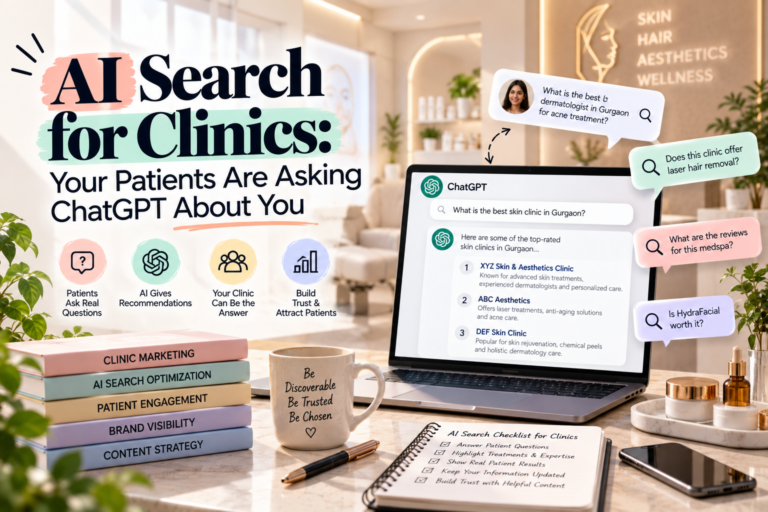
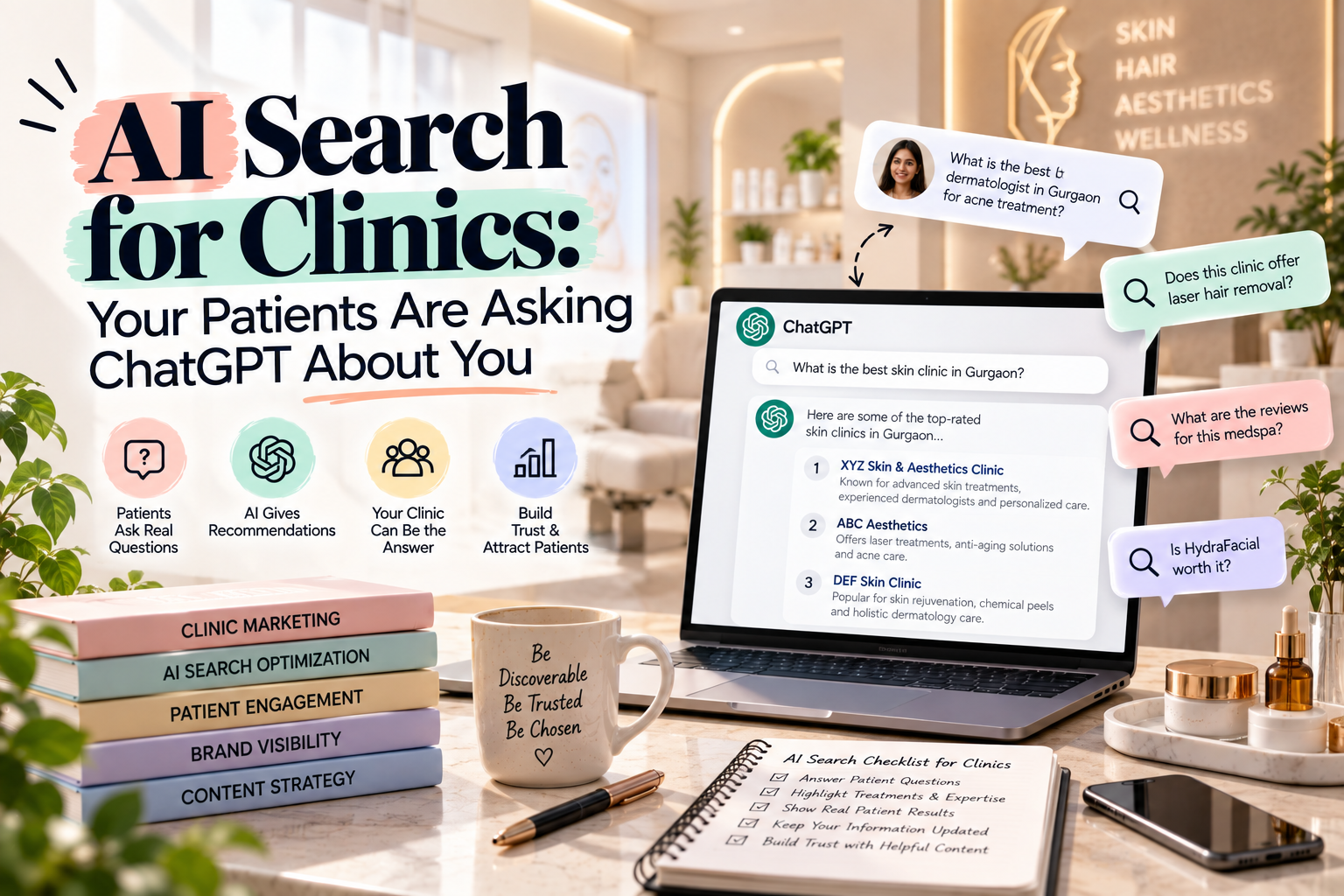
Dear clinic owners, AI search for clinics is no longer a future trend. Patients now ask ChatGPT, Gemini and Google’s AI features which clinic to trust, and the answer names a few practices before anyone opens a website. If your clinic isn’t one of them, you lose the patient before the first call.
Picture a patient in Gurugram at 11 pm, looking at acne scars in the mirror. She types into ChatGPT: “Which clinic in Gurugram is good for acne scar treatment, and what does it cost?” In the US, a June 2026 KFF poll found that 29% of adults now use AI tools for health information at least monthly, up from 17% two years earlier. Patients in India are asking the same kinds of questions.
Your reputation still matters. What’s changed is where patients check it first. This guide explains how AI tools choose which clinics to mention, five fixes that get clinics named, and a 30-day plan any clinic or MedSpa can follow.
Key Takeaways
- AI search for clinics decides which practices a patient hears about first, often before they visit any website.
- A June 2026 KFF poll found 29% of US adults use AI tools for health information at least monthly, up from 17% in 2024.
- AI tools name clinics whose treatment pages, credentials, listings and reviews give clear, consistent and verifiable answers.
- Five fixes help most: treatment pages that answer, descriptive reviews, up-to-date listings, visible doctor credentials and third-party mentions.
- Medical content needs extra care: factual statements, doctor review and no promised outcomes.
What Happens When a Patient Asks AI for a Clinic?
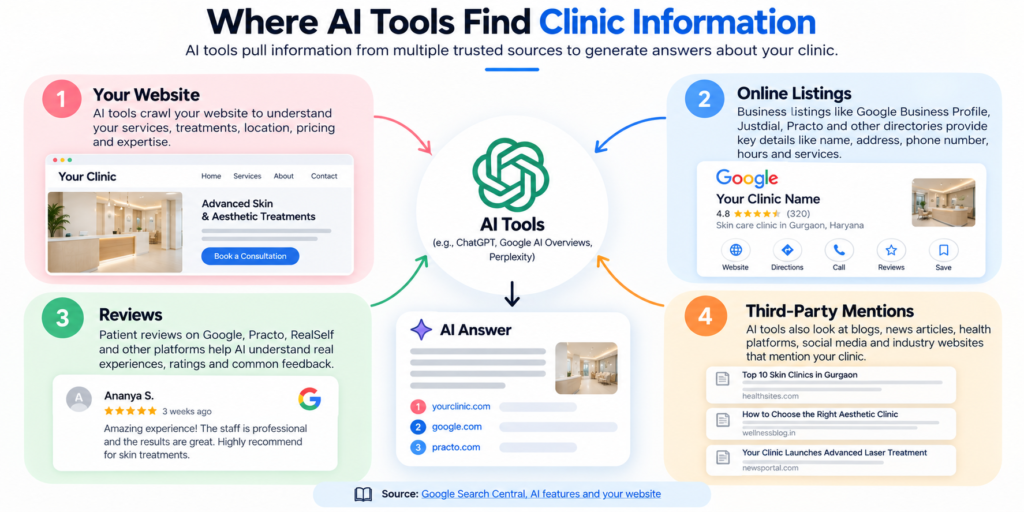
When a patient asks an AI tool for a clinic, the tool searches the web for relevant pages, reads them and writes a short answer that names a few practices. Google’s guidance on AI features and your website confirms that pages must be indexed and eligible to show a snippet to appear as a link in AI Overviews or AI Mode.
The tool pulls from several sources at once:
- Your website – treatment pages, doctor profiles, prices and location details.
- Listings – Google Business Profile, Practo, Justdial and similar directories.
- Reviews – what patients say about specific treatments and doctors.
- Third-party mentions – local news, health features and forum answers that mention your clinic.
That makes healthcare AI search different from classic clinic SEO. Ranking your homepage isn’t enough. The tool needs clear facts it can repeat with confidence, and it checks them against what other sources say.
Where Clinics Lose Patients Before the First Call
Most clinics that never appear in AI answers share one of three gaps:
- Vague treatment pages – a single “Skin Treatments” page listing 20 services gives an AI tool nothing specific to quote about acne scars, pigmentation or hair loss.
- Hidden credentials – doctor qualifications live only in a photo of a certificate, or not on the site at all.
- Mismatched details – the clinic’s timings, address or doctor list differ between the website, Google Business Profile and Practo, so the tool can’t tell which is right.
Each gap is fixable in a few weeks, and fixing them helps both regular clinic SEO and AI answers.
Five Fixes That Help AI Search for Clinics
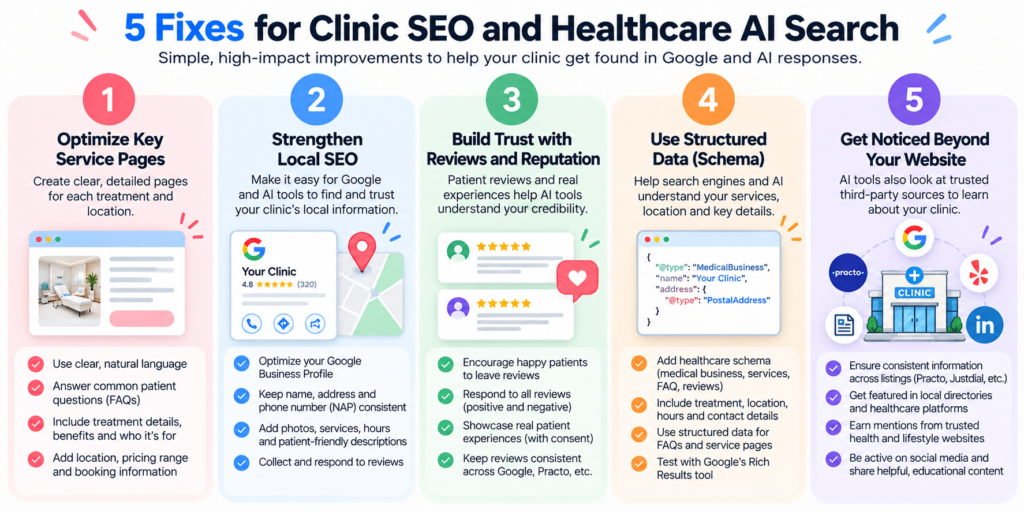
These five fixes cover what AI search for clinics looks for, and each one also strengthens regular clinic SEO.
1. Write treatment pages that answer patient questions
Create one page per treatment. Open with a 40 to 60 word answer covering what the treatment is, who it suits, how many sessions it usually takes and the price range. Then cover downtime, aftercare and who performs it.
Use question headings patients actually type, such as “How many sessions does laser hair removal need?” This answer-first layout is the heart of answer engine optimization, and it gives AI tools a clean block to quote.
2. Collect reviews that describe the treatment
Ask happy patients to mention the treatment and the location in their reviews, such as “PRP for hair fall at the Sector 56 clinic.” Descriptive reviews tell AI tools what your clinic is known for.
Reply to every review, including critical ones, calmly and without sharing patient details. A steady flow of genuine reviews matters more than a sudden spike.
3. Keep every listing up to date
Keep your name, address, phone, timings, doctors and services identical across your website, Google Business Profile, Practo and other directories. Add treatment categories and photos, and post updates regularly.
When details match everywhere, AI tools can describe your clinic with confidence. When they don’t, the tool may skip you or give patients the wrong timings.
4. Show your doctors’ credentials
Give every doctor a profile page with qualifications, registration details, years of practice and the treatments they perform. Write it in plain text, not inside an image.
Add structured data from schema.org, such as MedicalClinic and Physician, so machines can read who works at your clinic and what they do. This is also where “ChatGPT for doctors” questions get answered: patients often ask about a specific doctor by name.
5. Earn mentions on other trusted sites
AI tools trust what others say about you. Offer your doctors as expert sources for local health features, answer patient questions on Quora with care, and join health awareness events that get covered online.
This is the generative engine optimization side of AI search for clinics: the more credible sources connect your clinic with a treatment, the more likely AI tools are to name you.
Guardrails for Medical Content in AI Search
Health content affects people’s wellbeing, so both Google and AI tools hold it to a higher standard. Follow these guardrails on every page:
- State facts, not promises – say what a treatment involves and who it suits, never “guaranteed results.”
- Get doctor review – have a qualified doctor check every treatment page and add a “medically reviewed by” line.
- Show ranges, not fixed prices – price ranges with the factors that change them are more honest and more quotable.
- Follow advertising rules – check the medical advertising rules that apply to your practice before publishing claims or before-and-after photos.
A 30-Day AI Visibility Plan for Your Clinic
You can make real progress on AI search for clinics in one month:
| Phase | What to do |
|---|---|
| Days 1 to 7 | Ask ChatGPT, Gemini and Google 10 questions patients ask about your top treatments in your area, and note which clinics get named |
| Days 8 to 14 | Match your name, address, timings and doctors across the website, Google Business Profile and Practo |
| Days 15 to 24 | Rewrite your top five treatment pages answer-first, add price ranges and doctor profiles, and get medical review |
| Days 25 to 30 | Add MedicalClinic and Physician schema, request descriptive reviews from recent patients, and repeat the 10-question check |
For the bigger picture of how AEO, GEO and SEO fit together, see AEO vs GEO vs SEO.
For the complete step-by-step approach beyond clinics, read our AI search optimization guide.
How Will You Know Patients Can Find You?
You’ll know your clinic is gaining visibility when these four signals move:
- AI mentions – your clinic appears for more of your 10 test questions each month.
- Profile actions – more calls, direction requests and website clicks from Google Business Profile.
- AI referral visits – visits from chatgpt.com, perplexity.ai and similar sources in GA4.
- Booking source – more patients answering “ChatGPT” or “Google” when your front desk asks how they found you.
Write the Answers Your Patients Are Already Asking
AI search for clinics rewards the practices that answer patient questions clearly, prove who their doctors are, and keep their details consistent everywhere. This week, ask ChatGPT the three questions your patients ask most and see whether your clinic is in the answer.
If you’d like help making your clinic easier to find in Google and AI tools, idatecontent writes medically reviewed, answer-first content for clinics and MedSpas. If you’re comparing an SEO agency in Gurgaon, ask each one how they handle medical review and AI visibility.