Your monthly SEO report says rankings are up. Then a client mentions she found your competitor through ChatGPT, and a prospect tells you Google’s AI summary answered her question before she reached your site. Now three acronyms keep landing in your inbox, and every agency pitch promises all of them.
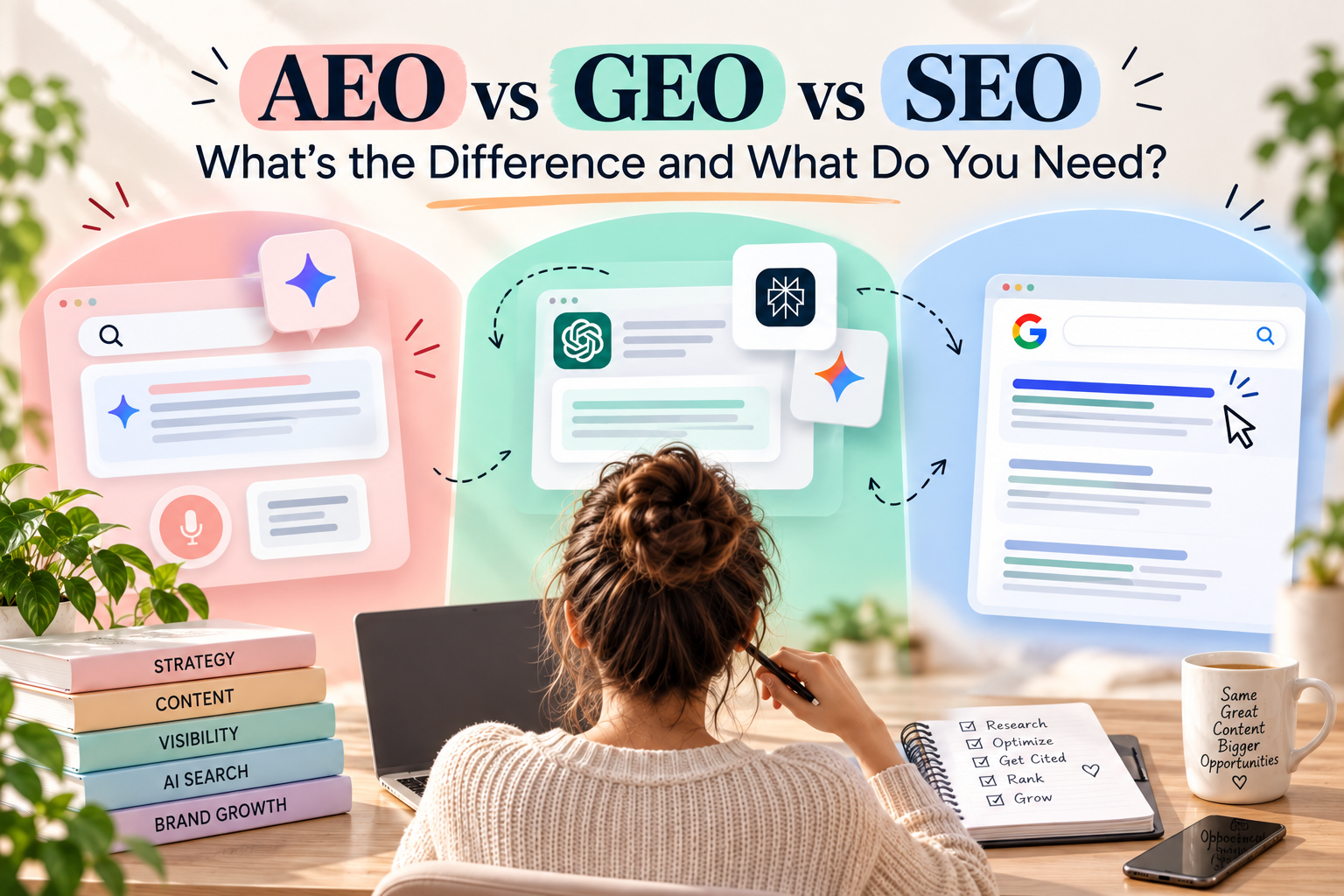
Here’s the short version. SEO gets your pages ranked in search results. Answer engine optimization (AEO) gets your content picked as the direct answer in featured snippets, voice search and AI Overviews. Generative engine optimization (GEO) gets your brand mentioned and cited inside AI chat answers. This guide explains each one with examples for clinics, real estate firms and B2B brands, and shows you which to work on first.
Key Takeaways
- SEO, answer engine optimization and GEO all start with the same thing: clear, useful SEO content on your own site.
- SEO targets rankings, AEO targets direct answers, and GEO targets mentions inside AI-generated responses.
- Most small and mid-sized brands need strong SEO writing first, then AEO formatting, then GEO signals.
- One content system can cover all three if every page answers a real question early and backs it with proof.
What Changed in Search Over the Last Two Years
Search used to end with ten blue links. Now many searches end on the results page itself. Google shows AI features like AI Overviews above the links, and people ask ChatGPT, Perplexity and Gemini questions they once typed into Google. You can rank well and still get fewer visits if your content isn’t part of those answers.
That’s why answer engine optimization and GEO became agency buzzwords in 2025 and 2026. Both describe ways to show up in answers as well as in rankings. The confusion comes from the overlap, because the same well-written page often helps with all three.
SEO, AEO and GEO Explained in Plain Words
1. SEO: getting your pages ranked
Search engine optimization helps your pages rank in Google’s regular results. It covers keyword research, SEO writing, internal links, page speed and backlinks. Google’s own SEO Starter Guide is still the best free overview of the basics.
Success looks like a real estate firm ranking on page one for “2BHK flats in Noida Extension” and getting enquiries from that traffic. You measure it with rankings, clicks and leads in Google Search Console.
2. Answer engine optimization: becoming the direct answer
Answer engine optimization shapes your content so search engines and voice assistants can lift one clear answer from it. The targets are featured snippets, the “People also ask” box, Google’s AI Overviews and spoken answers from Siri or Alexa.
A clinic that answers “how long does Botox take to work” in the first two lines of a post, under a heading that repeats the question, is doing answer engine optimization. The reader may get the answer without clicking, but your brand is the one giving it.
3. GEO: getting cited by AI chat tools
Generative engine optimization aims to get your brand mentioned or cited when tools like ChatGPT, Perplexity or Google’s AI Mode write an answer. The term comes from a 2023 research paper by researchers at Princeton, IIT Delhi and other institutions, which found that adding statistics, quotations and cited sources made content more likely to appear in AI-generated answers.
For a B2B SaaS brand, GEO success looks like ChatGPT naming you when someone asks for the best payroll software for Indian startups. That depends on your own pages and on what reviews, directories and articles across the web say about you. GEO also builds on answer engine optimization, since a page that already gives a clean answer is easier for AI tools to cite.
Answer Engine Optimization, GEO and SEO Side by Side
Here’s how the three compare side by side:
| Comparison Point | SEO | Answer Engine Optimization (AEO) | Generative Engine Optimization (GEO) |
|---|---|---|---|
| Goal | Rank pages in search results | Be the direct answer | Be cited or mentioned in AI answers |
| Where you show up | Google and Bing results | Featured snippets, People also ask, AI Overviews, voice search | ChatGPT, Perplexity, Gemini, Google AI Mode |
| What it rewards | Relevance, links, technical health | Clear question-and-answer structure, schema | Proof, statistics, brand mentions across the web |
| How you measure it | Rankings, clicks, leads | Snippet wins, AI Overview appearances | Mentions in AI answers, referral traffic from AI tools |
The overlap is bigger than the differences. All three reward content that answers a real question clearly, comes from a credible source and stays up to date.
Where Should Your Brand Start?
Most businesses need all three eventually, but the order matters. Start with what brings enquiries now and build from there:
- New website or low traffic: Start with SEO writing and the technical basics. Answer engine optimization and GEO can’t help pages Google hasn’t indexed.
- Ranking but losing clicks: Add answer engine optimization. Rework your top posts so the answer sits in the first 50 words under a question-style heading.
- Established brand in a competitive space: Add GEO. Collect reviews, get listed in industry directories and publish original data others will cite.
A Gurugram clinic with a two-year-old site that ranks for a few treatment pages sits in the middle group. For that clinic, answer engine optimization on its ten best-performing pages is likely to bring results sooner than chasing mentions in ChatGPT.
Writing One Page That Works for Search, Snippets and AI Chats
You don’t need three strategies or three agencies. You need SEO content written so each page works for rankings, direct answers and AI citations at once.
Answer first on every page – Put a 40 to 60 word answer to the main question at the top, then add detail. This one habit covers most of answer engine optimization and helps AI tools quote you accurately.
Add proof AI tools can cite – Include your own numbers, client examples, expert quotes and links to credible sources. Pages with specifics are easier to trust and easier to cite.
Earn mentions beyond your site – Keep your Google Business Profile updated, collect reviews, and get featured in industry roundups and local directories. AI tools pull from these sources when they describe a brand.
Your social content can use the same questions. An answer that works in a blog post also works as a Reel or carousel, and our guide on how to find content ideas shows where to find the questions your audience is asking.
Start With the Question Your Customer Is Asking
SEO, answer engine optimization and GEO describe where your content shows up: in rankings, in direct answers or inside AI chats. The work behind them overlaps heavily. Write clear, helpful SEO content, answer questions early, and give search engines and AI tools proof worth citing. This week, pick your five most visited pages and check whether each one answers its main question in the first two lines.
If you’d like a team to handle it, idatecontent plans and writes content for SEO, answer engine optimization and GEO for clinics, real estate firms and B2B brands. Before you hire any SEO agency in Gurgaon, ask them to show you one client page that appears in an AI answer.