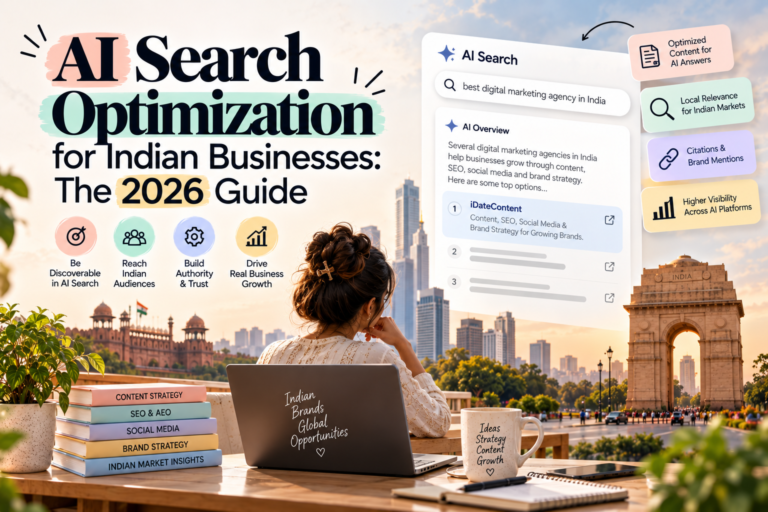
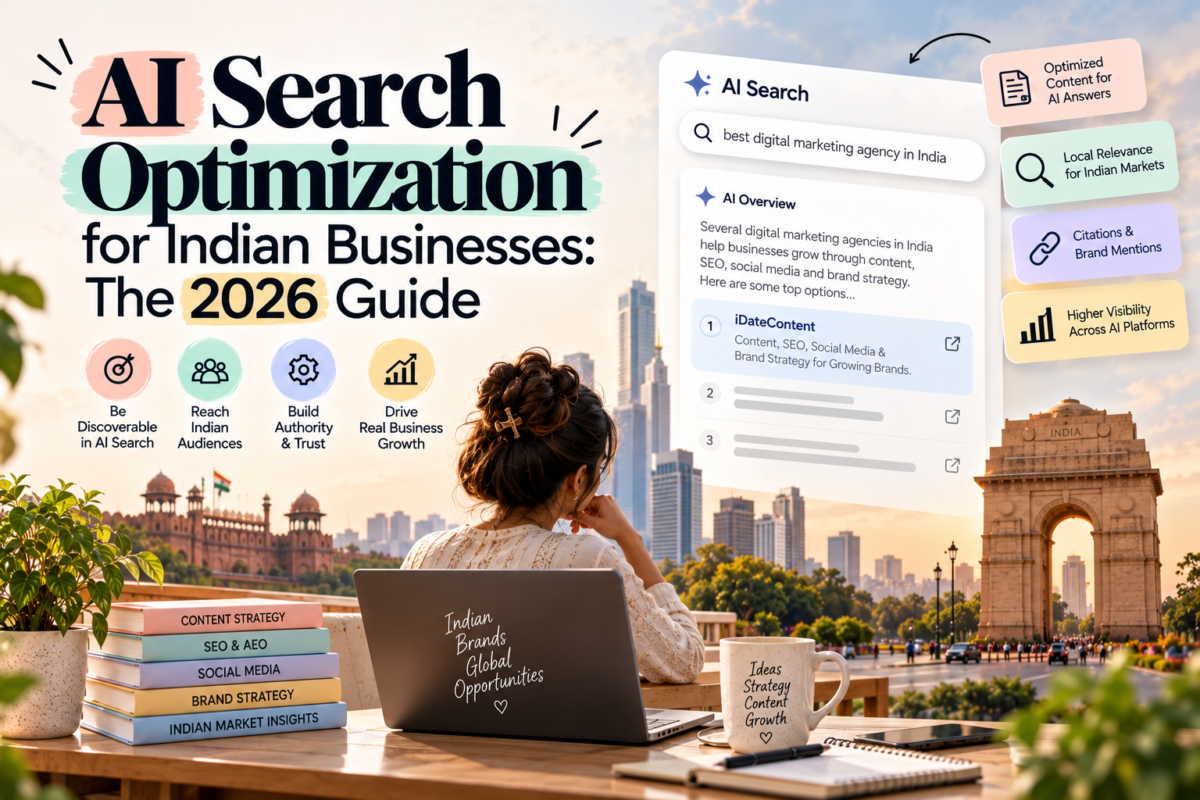
AI search optimization is the practice of shaping your website and online presence so AI-powered search tools can understand your brand, trust it and cite it in their answers. It builds on SEO and adds two layers: answer engine optimization and generative engine optimization.
The audience for AI search optimization is already there. Google said in July 2025 that AI Overviews had reached 2 billion monthly users across more than 200 countries and territories, and that AI Mode had passed 100 million monthly active users in the US and India. A patient in Gurugram can now ask Gemini for a dermatologist, and a founder can ask ChatGPT which CRM suits a 20-person team. The brands named in those answers get the inquiry first.
Ranking still matters, but it’s no longer the finish line. The new question is whether AI tools name you when your customers ask. This AI search optimization guide covers how AI search picks its sources, the CITED Framework, examples for clinics, real estate and B2B brands, and a 90-day plan.
Key Takeaways
- AI search optimization helps your brand get understood, trusted and cited by AI tools such as Google’s AI Overviews and AI Mode, ChatGPT, Gemini and Perplexity.
- AI search optimization combines SEO with answer engine optimization (AEO) and generative engine optimization (GEO).
- Google reported in July 2025 that AI Overviews had reached 2 billion monthly users, and that AI Mode had passed 100 million monthly users in the US and India.
- The CITED Framework covers the five things AI tools look for: crawlable pages, intent-led questions, tight answer-first writing, evidence and a consistent brand presence.
- Track brand mentions in AI answers every month alongside rankings, because some searches now end on the answer itself.
How Do AI Search Tools Pick the Brands They Mention?
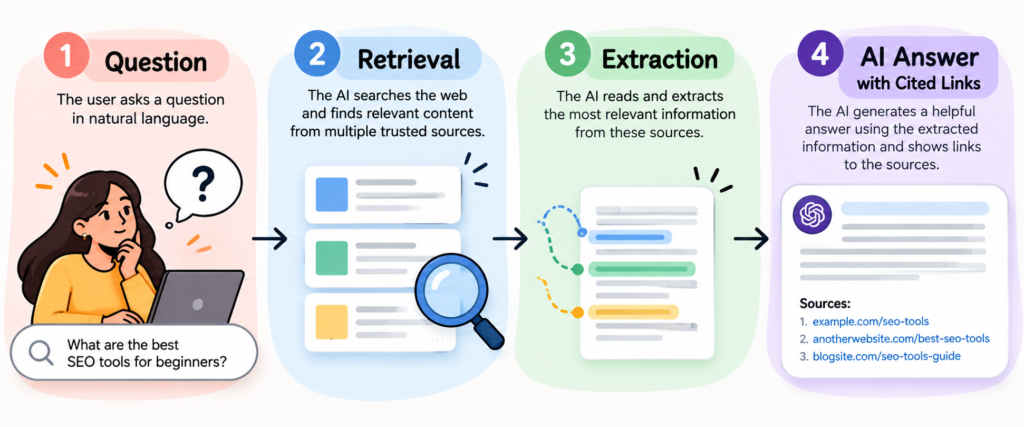
AI search tools usually work in two stages. First, they retrieve pages that seem relevant to the question from a search index or web crawl. Then a language model reads those pages and writes a summary, often linking the sources it used.
Google’s guidance on AI features and your website says there are no special requirements beyond SEO best practices: a page must be indexed and eligible to show a snippet in Search to appear as a link in AI Overviews or AI Mode. In practice, three things decide whether your brand shows up:
- Retrieval – your page has to be found and indexed for the question being asked.
- Extraction – the answer has to be easy to lift: clear, self-contained and specific.
- Confidence – the tool has to trust the source, based on signals across the web as well as your own site.
A Noida developer whose project page lists the RERA number, possession timeline, unit sizes and distance to the metro in plain sentences is far easier to quote than a page of brochure images with the details locked in a PDF.
What Does AI Search Optimization Cover?
AI search optimization, often called AI SEO, works on three layers, and each one depends on the layer below it:
- SEO – your pages can be crawled, indexed and ranked. Without this, nothing else works.
- Answer engine optimization (AEO) – your content gives direct answers that search engines can lift into featured snippets, “People also ask” boxes and AI Overviews.
- Generative engine optimization (GEO) – your brand gets mentioned or cited when ChatGPT, Perplexity, Gemini or Google’s AI Mode writes an answer.
We’ve covered the last two layers in our guides to answer engine optimization and generative engine optimization, and compared all three in AEO vs GEO vs SEO.
Five Gaps That Keep Indian Brands Out of AI Answers
Most brands that skip AI search optimization share one or more of these gaps:
- Thin, repetitive pages – dozens of near-identical posts don’t build trust, and Google’s spam policies treat scaled, low-value content as spam.
- Facts locked in images or PDFs – prices, credentials and specifications inside a brochure are hard for AI tools to read.
- Hype instead of specifics – “world-class” and “No. 1” give an AI tool nothing to repeat. Numbers, names and dates do.
- Inconsistent brand details – a different address on Google Business Profile, Practo or a property portal weakens confidence in your brand.
- Measuring only rankings – a page can rank well and still be missing from AI answers, so track both.
The CITED Framework for AI Search Optimization
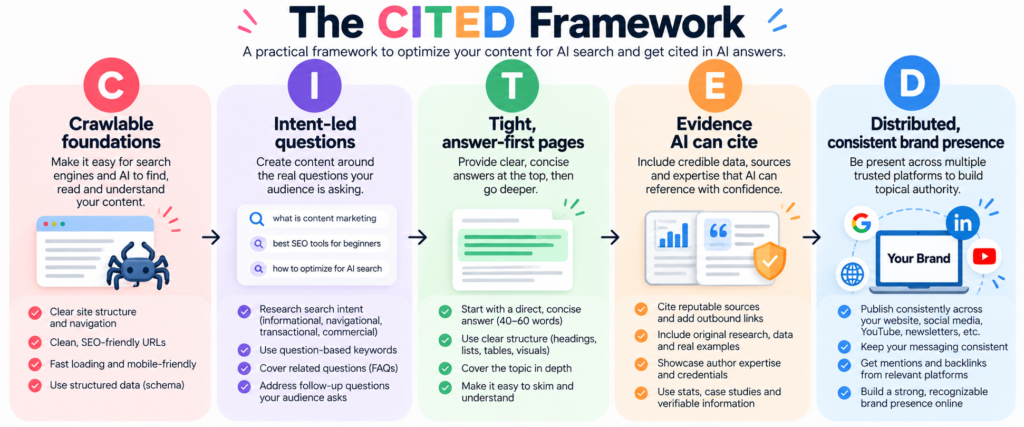
The CITED Framework turns AI search optimization into five working steps: Crawlable foundations, Intent-led questions, Tight answer-first pages, Evidence AI can cite and a Distributed, consistent brand presence.
C: Crawlable foundations
AI search optimization starts with crawlability: if Google can’t crawl and index a page, its AI features can’t use it. Verify your site in Google Search Console, submit a sitemap, fix pages marked “not indexed” and keep key facts in plain text, not behind scripts or logins.
Add structured data using schema.org types that fit your pages, such as Organization, LocalBusiness or MedicalClinic, Article and Product, and test each template with Google’s Rich Results Test.
I: Intent-led questions
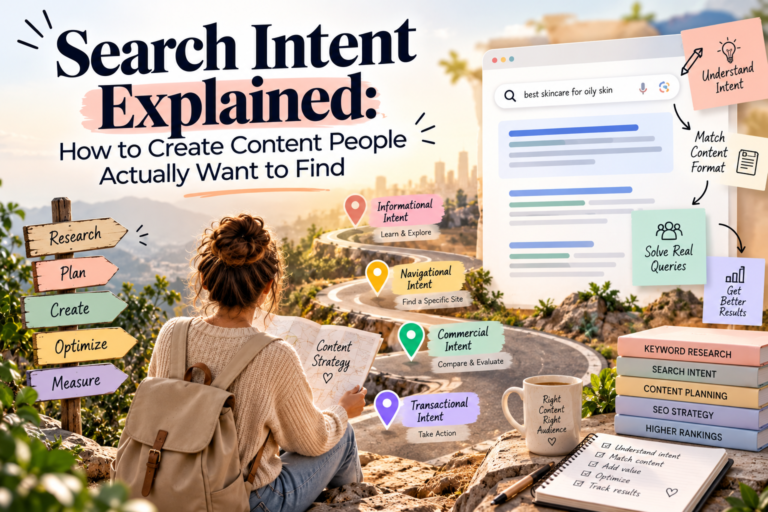
List the questions buyers ask at each stage, in their own words. Questions typed into AI tools tend to be longer and more conversational, such as “which dermatologist in Gurugram is best for acne scars and what does treatment cost?”
Ask yourself what customers ask on the first call, which options they compare you with, and what worries them before they pay. Then add questions from “People also ask” and Search Console. Our guide on how to find content ideas covers more sources.
T: Tight, answer-first pages
Put a 40 to 60 word answer to the page’s main question at the top, and open every section with a sentence that answers its heading. This is the core of answer engine optimization, and it gives AI tools a clean block to quote.
On a real estate page, “When is possession for Tower B?” followed by “Possession for Tower B is scheduled for [month and year], as per the project’s RERA registration” beats a paragraph about lifestyle. Our content optimization checklist covers the other on-page checks.
E: Evidence AI can cite
The research paper that introduced generative engine optimization found that adding statistics, quotations and cited sources made content more visible in AI-generated answers. Every key page needs real numbers, named sources and first-hand detail.
A clinic can list each doctor’s qualifications and years of practice. A developer can publish dated construction updates. A B2B brand can share a small benchmark from its own customers.
D: Distributed, consistent brand presence
AI tools build their picture of a business from many sources: your website, Google Business Profile, directories, reviews, LinkedIn and news mentions. Keep your name, services, location and positioning identical everywhere.
Then earn mentions beyond your site: expert quotes in industry publications, helpful answers on Quora or Reddit where your buyers ask questions, and original data others will reference.
AI Search Optimization for Clinics, Real Estate and B2B Brands
The CITED steps apply everywhere, but AI search optimization looks different in each industry:
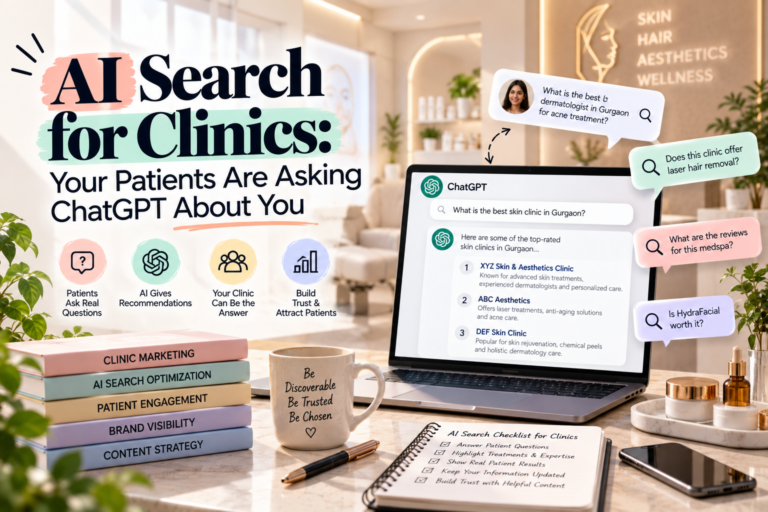
- Clinics and MedSpas – one page per treatment covering who it suits, sessions, downtime, price range and who performs it. Keep medical statements factual and doctor-reviewed, and keep Practo and Google Business Profile details matching your site.
- Real estate developers and brokers – text-based project pages with the RERA number, unit sizes, price range, possession timeline and distances to the metro and schools, plus locality guides that answer comparison questions like Dwarka Expressway versus Golf Course Extension Road.
- B2B and SaaS brands – comparison and alternatives pages, clear pricing explanations, integration lists and use-case pages, plus current profiles on software review sites such as G2 or Capterra.
A 90-Day AI Search Optimization Plan
This AI search optimization plan suits a small team working alongside regular SEO:
| Phase | Focus | Tasks |
|---|---|---|
| Days 1 to 30 | Foundations and questions | Fix indexing issues, add Organization and LocalBusiness schema, list 30 buyer questions, and record a baseline by asking 10 of them in ChatGPT, Gemini, Perplexity and Google AI Mode |
| Days 31 to 60 | Answer-first pages and evidence | Rewrite your top 10 pages answer-first, add credentials, dates and sourced numbers, and publish 4 to 6 pages that answer the top buyer questions |
| Days 61 to 90 | Brand presence and review | Align Google Business Profile and listings, earn 2 or 3 third-party mentions, then repeat the 10-question check and compare it with your baseline |
How Do You Track Visibility in AI Overviews and AI Chats?
Measure AI search optimization with a mix of mention tracking, traffic and lead data:
| Metric | Where to find it | What it tells you |
|---|---|---|
| Brand mentions for target questions | Monthly checks in ChatGPT, Gemini, Perplexity and Google AI Mode | Whether AI tools connect your brand with the topic |
| AI referral traffic | GA4 referral sources, such as chatgpt.com and perplexity.ai | Whether mentions bring visits |
| Impressions and queries | Google Search Console (traffic from AI features is counted in Search performance) | Whether Google shows your pages |
| Inquiries that mention AI | A “How did you hear about us?” field on forms | Whether AI visibility brings business |
Run the check the same way every month, with the same questions and tools, and log results in a sheet. AI answers vary between sessions, so look for trends over several months rather than single results.
Be the Source AI Tools Trust
AI search optimization is SEO that plans for the answer as well as the ranking. Make your pages crawlable, answer real questions directly, back every claim with evidence and keep your brand consistent everywhere AI tools look. This week, write down ten questions your customers ask, run them through ChatGPT, Gemini and Google, and note which brands get named.
If you’d like a team to build this for you, idatecontent plans and writes content for Google rankings and AI answers for clinics, real estate firms and B2B brands. If you’re comparing options for an SEO agency in Gurgaon, ask each one to show you how they track AI mentions.