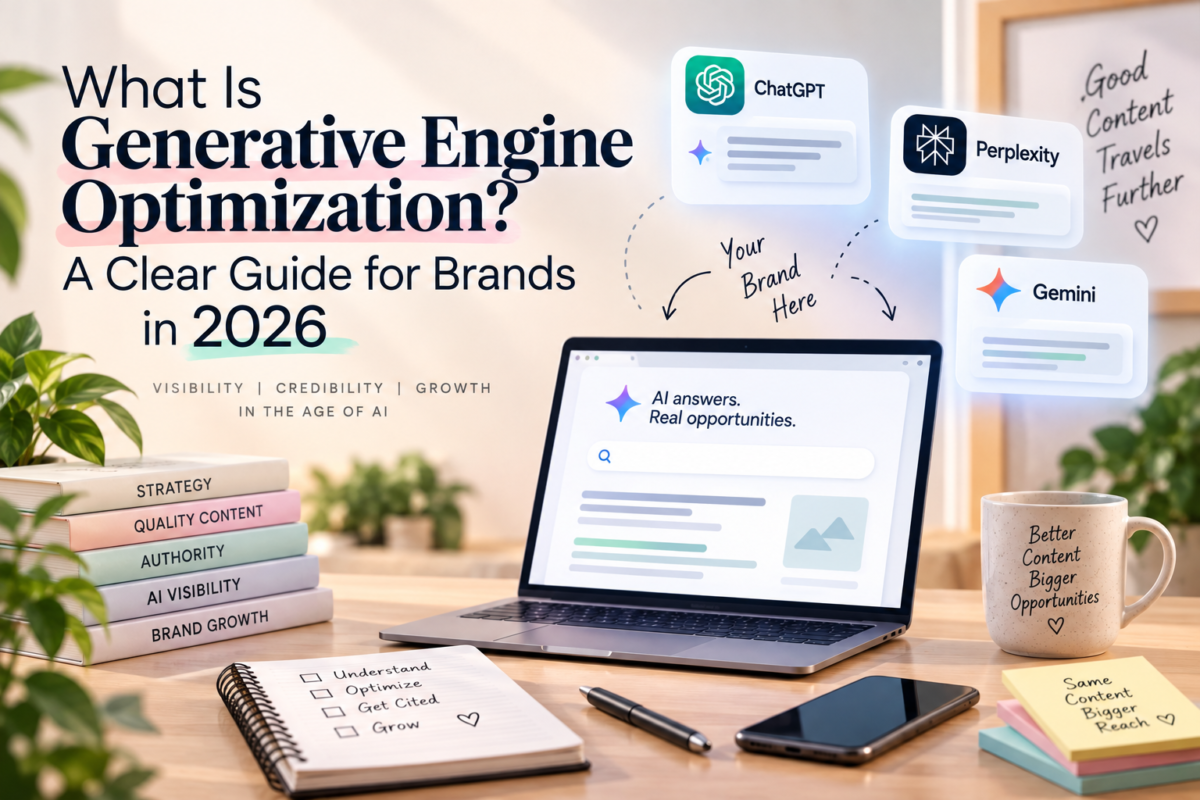
Your customers still search. They just don’t always search on Google anymore. More and more of them type a full question into ChatGPT, Gemini or Perplexity and trust whatever comes back. If your brand isn’t part of that answer, you’re invisible at the exact moment someone is ready to decide.
Generative engine optimization is how you fix that. This guide covers what GEO is, why it matters now, how it compares with SEO and answer engine optimization, and the practical content optimization steps that help AI tools recommend you.
Key Takeaways
- Generative engine optimization (GEO) means shaping your content so AI platforms cite, quote or recommend your brand in their responses.
- GEO works alongside SEO. Rankings still help, but AI tools also reward clarity, evidence and what others say about you.
- Research from Princeton, Georgia Tech and IIT Delhi found GEO tactics can lift AI visibility by up to 40%.
- The new success metric is how often you appear inside AI answers, not just how many clicks you earn.
What Is Generative Engine Optimization?
Generative engine optimization is the practice of making your content easy for AI systems to understand, trust and quote. Where SEO earns you a spot on a results page, GEO earns you a mention inside the answer itself.
The idea has academic roots. A research team from Princeton, Georgia Tech, the Allen Institute for AI and IIT Delhi formalized the term in a 2024 paper presented at KDD, a leading data science conference. Their tests showed that the right content changes could raise a source’s visibility in AI answers by as much as 40%.
Put simply, GEO asks one question of every page you publish. If an AI pulled a single paragraph from it, would that paragraph be clear, credible and worth repeating?
Generative engine optimization in brief: Generative engine optimization (GEO) is the practice of structuring and writing content so AI tools such as ChatGPT, Gemini, Perplexity and Google AI Overviews cite it in their answers. Researchers from Princeton, Georgia Tech and IIT Delhi formalized GEO in 2024 and found it can raise AI visibility by up to 40%.
Why Does Generative Engine Optimization Matter Right Now?
GEO matters because people increasingly get their answers without clicking through to a website. OpenAI reported 900 million weekly ChatGPT users in February 2026, more than double the figure from a year earlier. On Google’s side, BrightEdge data shows AI Overviews now appear on nearly half of all tracked searches.
That shift changes where attention goes. Pew Research Center found that when an AI summary appeared on Google, users clicked a regular search result in just 8% of visits. Without the summary, that number nearly doubled to 15%. Links inside the AI summary itself were clicked in only 1% of visits.
Does that mean search traffic no longer matters? Not quite. The visitors who do arrive from AI platforms often arrive ready to act. Adobe Analytics found AI-referred shoppers on US retail sites converted 42% better than other traffic in March 2026. Fewer visitors, but warmer ones, and the brands named in the answer get them.
Why GEO matters in brief: AI-generated summaries are reducing clicks to websites. Pew Research Center (2025) found Google users clicked a standard search result in 8% of visits when an AI summary was present, compared with 15% without one. For brands, being named inside AI answers is becoming a primary route to visibility.
GEO vs. SEO vs. AEO: What’s the Difference?
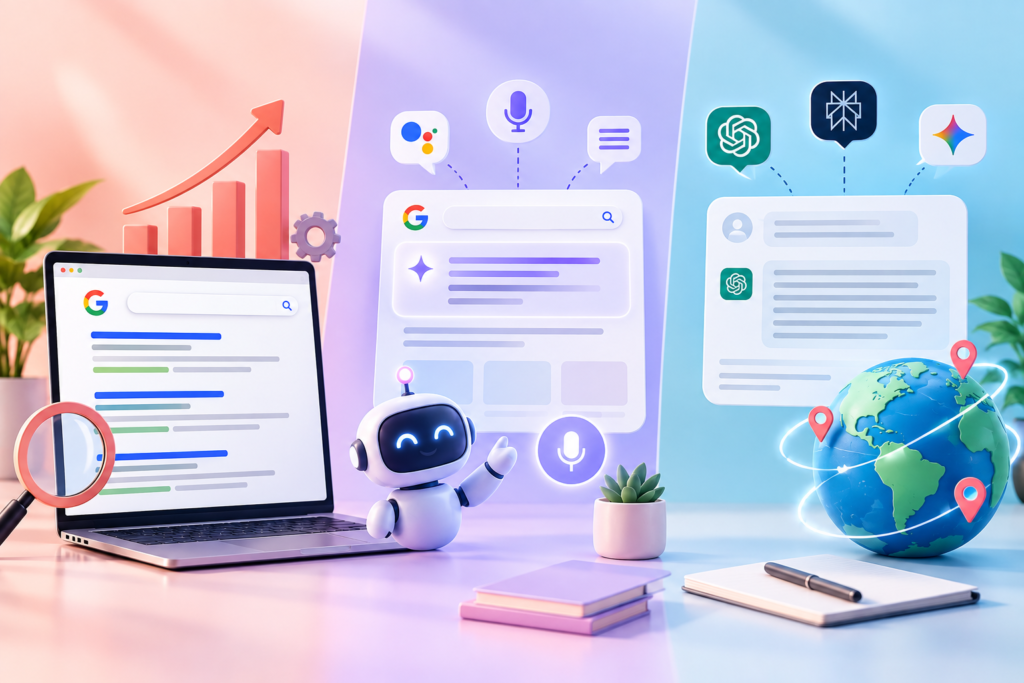
SEO, answer engine optimization and generative engine optimization build on each other, but each targets a different result. You need all three working together.
| Tips | SEO | Answer Engine Optimization | Generative Engine Optimization |
|---|---|---|---|
| What it aims for | High rankings in search results | Direct answers and featured snippets | Mentions and citations in AI responses |
| Where it shows up | Google, Bing | Snippets, voice search, AI Overviews | ChatGPT, Gemini, Perplexity, Claude, AI Mode |
| How you measure it | Rankings and clicks | Snippet wins | Brand mentions and share of AI answers |
Answer engine optimization works best for single, well-defined questions. You write the cleanest answer and aim to own that spot. GEO takes a broader view. AI tools stitch together information from several sources, so GEO focuses on becoming one of the sources they trust enough to include.
The two don’t always line up with Google rankings. A 2026 benchmark by ConvertMate found only 6.82% of ChatGPT results also appear in Google’s top 10, and 83% of AI Overview citations come from pages outside the organic top 10. Strong SEO keeps you in the game. GEO decides whether AI tools actually pick you.
How Do AI Engines Decide Which Brands to Mention?
AI engines lean toward sources that are specific, well-supported, easy to extract and referenced by others. Vague, generic content rarely makes the cut.
The Princeton-led study measured this directly. Adding relevant quotations improved visibility by up to 41%, adding statistics by 30 to 40%, and citing credible sources by around 30%. Keyword stuffing, on the other hand, performed worse than making no changes at all. The tactics that once gamed search engines now work against you.
There’s an encouraging detail for growing brands. Lower-ranked sites in the study saw the biggest gains. Pages ranked fifth improved their AI visibility by 115% after adding source citations, while top-ranked pages saw no such lift. Quality and clarity can outweigh size.
Your reputation off-site plays a big part too. Research from Muck Rack found 82% of AI citations come from earned media, such as news coverage and third-party articles, rather than brand-owned pages or paid placements.
How AI picks sources in brief: AI engines favor content that is specific, evidence-backed and mentioned by third parties. The 2024 Princeton-led GEO study found quotations, statistics and cited sources raised AI visibility by 30 to 41%, while keyword stuffing lowered it. Muck Rack research found 82% of AI citations come from earned media.
Generative Engine Optimization Tactics You Can Use Today

The most effective GEO approach is to create content an AI can quote confidently without needing extra context. These content optimization habits make the biggest difference.
Answer first, explain second
Start every section with a direct one or two sentence answer to its heading. AI tools often extract the opening lines under a heading, so your clearest point belongs right there.
Back claims with named data
Swap vague phrases like “research suggests” for the organization, the finding and the year. Specific numbers give AI something concrete to repeat. Named sources give it a reason to believe you.
Make every paragraph stand on its own
Write paragraphs that make sense if read in isolation. Cut references like “as we covered earlier.” Self-contained passages are far easier for AI tools to lift and attribute.
Build a clear page structure
Use headings phrased as real questions, short paragraphs, comparison tables and a FAQ section. Add schema markup for articles, FAQs and your organization so machines can read your structure as easily as people do.
Grow your presence beyond your website
Contribute expert quotes to industry publications, write guest articles, earn reviews and take part in genuine community conversations. Keep your brand name, services and details consistent everywhere so AI tools connect the mentions back to you.
Refresh content on a schedule
Revisit key pages every few months to update figures, dates and examples. AI answers on fast-moving topics favor recent information, and stale data can quietly cost you a mention.
How Can You Track Your GEO Performance?
You track generative engine optimization by checking how often AI platforms mention your brand for the questions your buyers ask. Traditional metrics still count, but they only show part of the story.
A simple starting point works well. List 20 to 30 questions a potential customer might ask about your category. Each month, run them through ChatGPT, Gemini, Perplexity and Google’s AI features. Note whether your brand appears, how it’s described and which competitors show up in your place.
Alongside that, monitor referral traffic from AI platforms in your analytics and watch for growth in branded searches. As your prompt list grows, AI visibility tools can automate the tracking. What you want is a rising trend: more mentions this quarter than the last.
Getting Started With Generative Engine Optimization
Generative engine optimization changes the goal of your content. Ranking is still useful, but being quoted is what keeps your brand in front of buyers who never scroll past the AI answer. Clear answers, named data and a presence beyond your own site are the three things that move the needle most.
You don’t need to overhaul everything at once. Pick your five most important pages, rework them with GEO in mind, and start tracking where your brand appears in AI responses.
Curious how your brand shows up in AI answers today? The idatecontent team can run a GEO content audit and map out exactly where to begin.